
Kraffic field notes · original screenshot
Our Google impressions fell. What did we check?
Published: · Last reviewed: · By Nick
Short answer
Across our guide’s www and non-www addresses, Google impressions fell from 407 to 253 across two seven-day periods. Clicks stayed at zero. We rechecked the figures in Search Console on 12 November 2026. This is a small, descriptive observation, not proof of what caused the fall or how to reverse it.
Key takeaways
- Compare the same dates, page scope and search type before changing the site.
- The www row alone showed 340 to 253. Including the non-www row gave 407 to 253. The URL scope changes the comparison.
- A 37.8% impressions decline is not a 37.8% loss of clicks: both weeks had zero clicks.
- Search Console reports Google performance. These figures do not measure ChatGPT citations.
Prompts this guide answers
- “why did my Google impressions drop”
- “why does the non-www URL show zero impressions”
Practical check
Impressions changed. What should you check first?
- Match the scope
- Compare equal-length periods with the same property, search type and URL filters. Read both URL versions before interpreting the total.
- Separate the measures
- An impressions decline is not evidence of lost clicks or a penalty. Check clicks and affected queries, then investigate other explanations.
Download these field notes
Download the Google impressions field notes (PDF). Includes the published comparison, methods and limitations. This is a descriptive observation, not a causal experiment.
Related Google questions
- We searched “why Google impressions dropped” on Google on 12 November 2026, in desktop Chrome. Google showed India / New Delhi and personalised results. This is a dated search observation, not search-volume research.
- Relevant related-search wording included: “GSC impressions drop”; “Google Search Console impressions”; “Google traffic drop”; “Google Discover traffic drop”.
- The visible People Also Ask results mixed in unrelated topics. We excluded those. The practical questions below are our editorial follow-ups, not a claim that Google displayed them verbatim. This does not establish that our questions are unique.
- Does a drop in impressions mean my site was penalized? No. Check reporting scope, indexing, query demand, seasonality, ranking changes and technical issues before assigning a cause. A chart alone does not establish a penalty.
- How can I check whether the fall is seasonal? Compare equivalent periods and year-over-year data, then examine affected queries in Google Trends. Keep search type and filters consistent. Small samples and incomplete dates limit the conclusion.
- Should I rewrite my pages after a small ranking drop? Not automatically. Google advises avoiding radical changes to already-performing pages for small position movements. Investigate the affected queries and pages before choosing a fix.
- Check the official guidance behind these answers.
Workflow for your AI assistant
- Get the plain-text guide or Markdown version. Save the file, attach it where supported, or paste its text into your chat. Use the starter prompt inside.
- The guide tells your assistant what evidence to request, what to check, what not to do and how to report an uncertain result. It does not give the assistant access to your accounts.
- Read the instructions for ChatGPT, Claude, Gemini, Grok and DeepSeek. These are portable reference documents, not a universal native skill installer.
- Tested as of 12 November 2026: content, download structure and one assistant scenario per guide were checked. The underlying case has its own observation dates. The five named apps were not runtime-tested for this release.
- Tools and policies change. Ask your assistant to check the current official sources before use and tell you if it cannot. Downloaded files do not refresh automatically or retrain a model. No outcome is guaranteed.
- Share only redacted evidence. Keep IDs, passwords, codes, private client data and verification links out of chat.
The research question
- Our guide had fewer Google impressions. One URL version also showed zero. We needed to separate a reporting-scope question from a genuine decline.
- We looked at our own website, not a client account. The page was /guides/how-to-rank-in-chatgpt.
What we checked and when
- Rechecked in Google Search Console on 12 November 2026. Property: kraffic.ai domain property. Report: Performance, Search type Web (text).
- Compared 14–20 October 2026 with 21–27 October 2026. Both are seven-day periods. These are the report’s date labels.
- Page filter: URLs containing /guides/how-to-rank-in-chatgpt. The Pages table returned exactly two rows: the www and non-www versions of that guide.
- No country, device or query filter was applied. We read the totals and the two page rows separately.
- The screenshot is a real capture from this recheck, cropped to remove account UI. It is not a reconstructed dashboard. The full page-filter text is recorded above because the screen shortens it. Open the full-size screenshot.
Original comparison, rechecked on 12 November
Read the dates under each metric. The later week appears above the earlier week. The screenshot warns that chart totals and table results may be partial when filters are applied. Google’s data-discrepancy guidance distinguishes page-filter aggregation, table row limits and anonymized-query handling. This warning does not establish that rows were missing from our two-row Pages table or explain the decline; we applied no query filter.
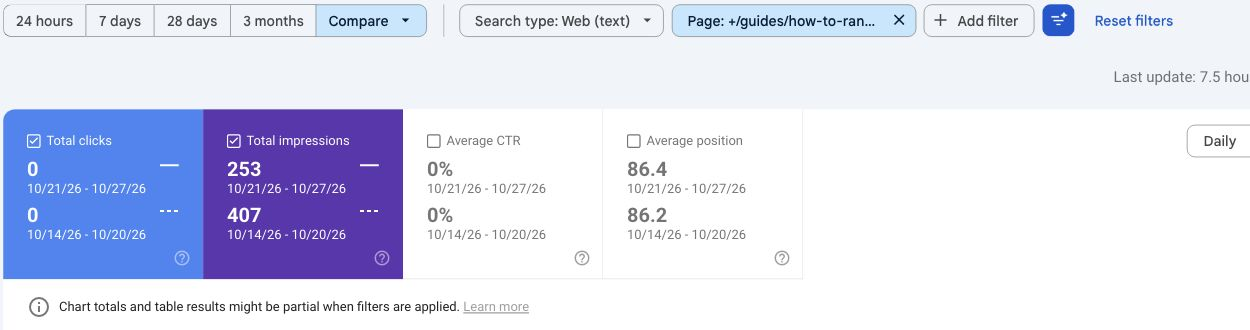
Actual Kraffic report, captured 12 November 2026. Search type Web (text); guide-path filter; no country, device or query filter. Cropped for privacy; values unchanged.
What the report showed
- Total impressions: 407 in 14–20 October, then 253 in 21–27 October. Difference: 154 fewer, or 37.8%.
- Clicks: zero in both periods. The report does not show a loss of clicks between these weeks.
- Average position: 86.2, then 86.4 across the filtered scope. The first week includes impressions under both addresses; the second has only the www row. This changing mix can hide individual query or URL changes, so do not read it as stable rankings.
- www page row: 340, then 253 impressions. Non-www page row: 67, then zero. The two rows reconcile to the displayed totals. We transcribed these rows during the live recheck; the cropped screenshot shows the totals, not the row breakdown.
- Download the transcribed comparison. This CSV is our transcription of visible values, not a native Google export.
Why zero did not mean disappearance
- A zero on one URL row is not the same as zero across both versions. Check the other version before concluding that the whole guide disappeared.
- Our investigation note dated 1 November 2026 recorded the non-www redirect and Google choosing the www version. That later observation does not establish which canonical Google used during 14–20 October. This article’s fresh recheck reproduces the performance figures, not that historical URL-inspection screen.
- Google explains how Performance data is attributed to canonical URLs. Check your own selected canonical rather than assuming the same setup.
What the timing tells us
- Our investigation notes record major page edits starting on 28 October. The two periods above end on 27 October. Those later edits cannot explain a decline already present in this comparison.
- That only rules out those later edits as the cause of this earlier change. It does not prove what did cause it, or rule out an effect on later weeks.
- The decision supported by these checks: do not roll back later changes solely because this earlier comparison fell.
Repeat the check on your site
- Save the exact question first: impressions, clicks, indexing, or AI citations? These are different outcomes.
- Choose the same length periods and record the property, search type, page filter, country and device. Keep recent incomplete dates out of final comparisons.
- Check Google’s reported data anomalies for the same report and dates. A nearby incident in another report does not explain this comparison.
- Check both URL versions and the Pages table. Do not add unrelated pages to make the result look better.
- Read query, country and device changes separately. Compare longer history when available before calling two weeks a trend.
- Put release dates beside the daily report. A later edit cannot cause an earlier decline.
- Check indexing and selected canonical separately. Save that evidence with its own check date.
- Download the investigation checklist. Keep source evidence private when it contains client details.
What remains unknown
- We have not established the cause of the decline. Two small weekly samples cannot isolate demand, ranking changes, query mix, measurement differences or normal variation.
- No controlled test or recovery result is presented. The nearly unchanged aggregate position does not settle the query-level question.
- The original daily export and longer baseline are not published here. The screenshot and transcribed summary allow the displayed comparison to be checked, not the whole causal investigation.
- This does not show whether ChatGPT mentioned or cited us. That needs a separate, repeatable AI-answer test.
Is this question unique?
- No. Google’s traffic-drop guide already describes the broader investigation.
- Our added value is the actual small-site example: the two URL rows, exact comparison, unchanged zero clicks, edit timing and the decision we avoided.
- We checked competing guidance, but did not run an exhaustive originality study. We do not claim to be the first to explain these checks.